Structural Drying Services in Lincoln, NE
Water Damage Lincoln NE provides professional structural drying in Lincoln, Nebraska — moisture mapping, commercial air movers, low-grain-refrigerant dehumidifiers, and daily moisture logs until every material hits dry standard. Call +1 (402) 227-8606. From soaked basements in the North Bottoms to flooded offices near the O Street corridor, we dry the structure — not just the surfaces.
24/7 emergency response across Lincoln & Lancaster County
Extraction removes the water you can see. Structural drying removes the water you can’t — the moisture wicked six inches up drywall, pooled under subfloor, trapped inside wall cavities, and soaked into framing. This is the phase where amateur jobs fail and mold jobs begin. Mold can start growing within 24–48 hours on wet drywall, wood, and carpet (EPA), and Lincoln’s humid summers give it ideal conditions. Drying is applied psychrometrics — the physics of evaporation and dehumidification — not a weekend of box fans. This page explains how professional structural drying actually works, what equipment does what, and how you know when a building is truly dry.
Psychrometrics: The Science Behind Every Drying Job
Structural drying is applied psychrometrics — the science of how air temperature, humidity, and dew point drive evaporation. Warm, dry air pulls moisture out of wet materials; a dehumidifier strips that moisture from the air so the cycle continues. Every drying plan we write starts from measured psychrometric readings, not from guessing how many fans “feel right.”
The cycle has three moving parts. Evaporation: warm air moving across a wet surface converts liquid water into vapor — this is what air movers do. Dehumidification: the vapor has to go somewhere, or humidity climbs until evaporation stalls — this is what dehumidifiers do, dropping the air’s moisture content so it can absorb more. Temperature control: warmer air holds more moisture, so controlled heat (or simply not air-conditioning the space to 65°F) keeps the cycle efficient. The three are measured in grains of moisture per pound of air — a dehumidifier that pulls the air from 90 grains down to 40 grains has fundamentally changed what that air can absorb. When a contractor tells you “we’ll put some fans on it,” ask what their target grain depression is. If the answer is a blank stare, they don’t do structural drying — they do air circulation. Our water damage repair page shows how drying fits into the full restoration process.
120-200+ pints/day
Commercial LGR dehumidifier
vs. 30-50 pints for a home unit
3-5 days
Typical residential drying
to verified dry standard, not just feel
24-48 hours
Mold clock
EPA — on wet drywall, wood, carpet
Moisture Mapping: Finding the Water You Can’t See
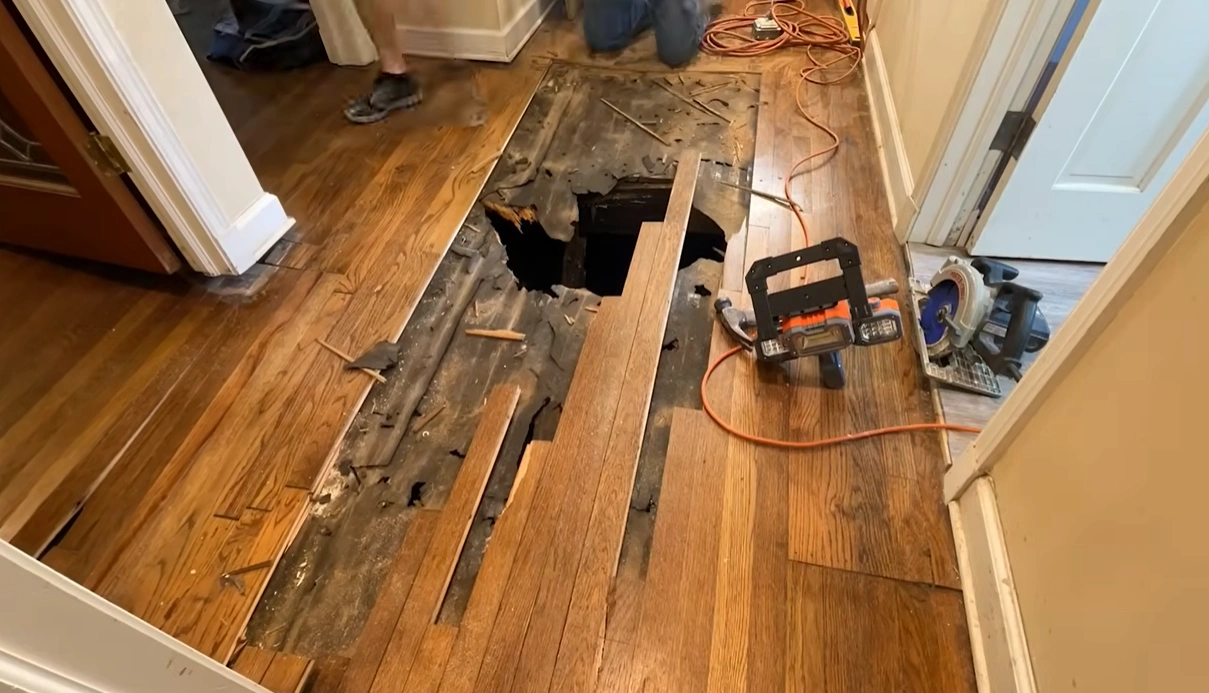
Moisture mapping finds water hidden inside walls, under flooring, and above ceilings — using pin and pinless moisture meters plus thermal imaging — before a single piece of equipment is placed. We don’t dry what we can see; we dry what we measured. You get the map: which materials are wet, how wet they are, and exactly where the equipment goes.
Water travels. A burst pipe in a Hartley bungalow wets the drywall at the baseboard, wicks upward through the paper backing, soaks the bottom plate and the sill, and migrates under the subfloor into the next room — while the visible puddle sits in one spot. A pin meter reads moisture content inside wood framing; a pinless meter scans drywall and plaster without punching holes; thermal imaging shows the cool signature of evaporating moisture across a wall surface, revealing patterns invisible to the eye. This map decides everything: how many air movers, where the dehumidifiers go, whether a flood cut is needed, and what the drying goal is for each material. It also becomes your documentation — the “before” reading every future reading is measured against. See how mapping starts on emergency arrival and feeds the mold prevention strategy that depends on it.
LGR Dehumidifiers: Why the Equipment Gap Decides the Outcome
Low-grain-refrigerant (LGR) dehumidifiers pull moisture down to levels a home dehumidifier physically cannot reach — they keep drying when the air gets dry, which is exactly when cheap equipment quits. A residential unit from the hardware store stalls around 50–60% relative humidity; an LGR keeps pulling into the 30s and below, which is the range where framing, subfloor, and drywall actually reach dry standard.
The numbers tell the story. A typical home dehumidifier removes 30–50 pints of water per day in ideal conditions and gives up as the room dries. A commercial LGR removes 120–200+ pints per day and keeps working in the low-humidity range where the last, hardest moisture lives — inside wall cavities and under flooring. That final 10% of moisture is the 10% that grows mold. This is why the “weekend of box fans” fails: fans evaporate water into the air, but without a dehumidifier stripping that vapor out, the room’s humidity climbs until evaporation stops and the water simply redistributes — often condensing on cooler surfaces like windows and exterior walls. We size dehumidification to the cubic footage and the moisture load, place units per the moisture map, and verify with daily readings. No guessing, no “looks dry.”
Air Movers: Controlled Airflow, Not Just Blowing Air
Air movers create high-velocity, laminar airflow across wet surfaces to maximize evaporation — placed at precise angles to the wall-floor junction, one every 10–14 linear feet of wet wall, angled to push the boundary layer of saturated air off the surface. It’s a placement science, not a fan count. More fans in the wrong positions just waste electricity; the right fans in the right positions cut days off a drying schedule.
The physics: a thin layer of still, moisture-saturated air clings to every wet surface — the boundary layer. Evaporation can’t happen faster than moisture can cross that layer, so an air mover’s job is to continuously strip it away and replace it with drier air. That’s why placement matters more than quantity: a mover aimed at the wet wall-floor angle does more work than three fans blowing at the ceiling. We also use specialty airflow where it counts — wall-cavity drying systems that inject dry air behind drywall through small ports (saving the wall instead of cutting it out), and floor-mat systems that pull moisture from hardwood without cupping it. See our hardwood floor and ceiling pages for material-specific drying, and our extraction page for what happens before the air movers arrive.
Water Damage Can't Wait
Every hour you wait, the damage spreads. Call now and get a straight answer about timing and next steps.
Drying Goals and Daily Moisture Logs: How You Know It’s Actually Dry
” Dry” isn’t a feeling — it’s a number. Every material has a dry standard: the moisture content of comparable unaffected material in the same building, measured on day one. We log pin-meter and thermo-hygrometer readings daily until every affected material returns to its dry standard, and we show you the log. A building is dry when the numbers say so, not when the carpet feels dry to your hand.
Here’s why the log matters more than the equipment. Carpet can feel dry while the pad underneath still reads saturated; drywall can look fine while the bottom plate behind it reads 30% moisture content; a wall that “seems dry” after two days can still be feeding mold inside the cavity. The daily log catches all of it — and it’s the single most persuasive document in an insurance claim, because it proves the work was necessary, measured, and complete. We follow ANSI/IICRC S500 drying principles as the industry standard for the work (referenced as a standard, never as a certification — Nebraska registers contractors through the Department of Labor; there is no statewide contractor license). When a competitor tells you “three days should do it” without a single meter reading, you’re not buying drying — you’re buying hope. Our insurance claims guide explains how drying logs support your claim.
Why a Weekend of Box Fans Fails — The Honest Math
A weekend of box fans fails because fans only move moisture from surfaces into the air — without dehumidification, the air saturates, evaporation stalls, and the water condenses back onto cooler surfaces or stays trapped inside materials. Meanwhile mold’s 24–48-hour clock (EPA) keeps ticking. By Monday, the room smells “a little musty,” the drywall looks fine, and mold is colonizing the back of the baseboards where you’ll find it months later.
This is the most expensive mistake in water damage, and it’s everywhere in Lincoln after every storm. The October 2026 flood filled hundreds of basements — from the North Bottoms to Yankee Hill — and plenty of homeowners did the fan weekend. Here’s what they missed: the water wicked up the drywall (flood cuts exist because drywall wicks 12–24 inches upward), soaked the insulation (wet insulation loses its R-value and holds moisture against the studs), and pooled under the carpet pad (pad is a sponge that almost never dries in place). The visible room dried; the assembly didn’t. Two months later: musty odor, baseboard mold, a mold remediation bill on top of the drying bill they thought they’d avoided. Professional structural drying costs less than professional structural drying plus mold remediation. If your basement took water in the October 2026 storm and never got professional drying, our flood hub has a 30-day action plan — late is better than never.
Frequently Asked Questions: Structural Drying in Lincoln
Straight answers to the questions Lincoln homeowners ask about drying out buildings after water damage — timelines, equipment, dry standards, and what happens when drying is skipped. For active water damage, call +1 (402) 227-8606.
How long does it take to dry out a building after water damage?
Typical structural drying runs 3–5 days for a residential room or basement, with daily moisture readings logged throughout. Larger losses, hardwood floors, and wall cavities take longer — sometimes 7–10 days. The honest answer is “until the meters say dry”: materials have individual dry standards, and we don’t pull equipment until every affected material hits its number, not when the calendar says so.
Can water damage be reversed?
The water itself can be fully removed and the structure dried to its pre-loss moisture content — that’s what structural drying does. But materials that were destroyed can’t be un-destroyed: drywall that wicked sewage, carpet pad that sat in Category 3 water, and insulation that lost its R-value get removed and replaced. Fast professional drying is what keeps a job in the “reversed” column instead of the “replaced” column.
How do you know when a wall is actually dry?
Pin and pinless moisture meters read the moisture content inside the material, compared against the dry standard measured from unaffected material in the same building on day one. Thermal imaging confirms there are no hidden wet pockets. A wall is dry when its readings match the dry standard across multiple days — not when it looks or feels dry, which can be off by a week or more.
Do I need to remove drywall after flooding?
It depends on the water category and how high it wicked. Clean water dried fast sometimes saves drywall; gray or black water (sewage, floodwater) means the bottom 12–24 inches come out — the standard “flood cut” — because contaminated porous material can’t be reliably sanitized. Moisture mapping tells us exactly where the wicking stopped, so we cut only what’s necessary and keep what dried clean.
Will my hardwood floors dry out on their own?
Almost never without help — and waiting usually makes it worse. Hardwood cups and crowns as it absorbs water unevenly, and the subfloor underneath stays wet long after the surface looks dry. Professional drying uses floor-mat systems that pull moisture from below while controlling the surface, often saving floors that a “wait and see” approach would have destroyed. See our hardwood floor page for the full protocol.
What’s the difference between an LGR dehumidifier and a regular one?
An LGR (low-grain-refrigerant) dehumidifier keeps removing moisture in low-humidity conditions where conventional refrigerant dehumidifiers — including every home unit — stall out. LGRs remove 120–200+ pints per day and dry air down to the grain levels where framing and subfloor actually reach dry standard. That final stretch of drying is where mold prevention happens, and it’s exactly where home equipment quits.
Why does my basement still smell musty after drying?
A musty smell after “drying” means something is still wet or already growing mold — usually behind baseboards, under carpet pad, inside wall cavities, or in soaked insulation that was never removed. Surface drying doesn’t reach these spots. We find the source with meters and thermal imaging, remove what’s contaminated, and dry the assembly to standard — the smell leaves when the moisture does.
Can I rent the equipment and dry it myself?
You can rent air movers and dehumidifiers, but equipment without measurement is just noise — the meters, the moisture map, the dry standards, and the daily logging are what make drying work. Rental LGRs are also frequently undersized for the moisture load, and misplacement wastes days while mold’s 24–48-hour window (EPA) closes. For anything beyond a small clean-water spill caught in minutes, professional drying costs less than the mold job that follows DIY drying.
How is structural drying documented for insurance?
We log moisture readings daily from first measurement through dry standard, photograph equipment placement and affected areas, and record equipment types with run times. This log proves the drying was necessary, professionally executed, and complete — it’s the backbone of the water mitigation portion of your claim. Our insurance claims guide explains how adjusters use this documentation.
Is structural drying covered by homeowners insurance?
Drying is part of water mitigation, which is covered whenever the underlying water event is covered — sudden burst pipes, appliance failures, storm-driven roof leaks. If the water source is excluded (floodwater without flood insurance, long-term seepage from deferred maintenance), the drying isn’t covered either. Fast professional drying also fulfills your duty to mitigate further damage, which insurers require before they’ll pay the larger claim.
Call Water Damage Lincoln NE — Measured Drying, Documented Results
If water got inside your walls, under your floors, or into your framing, the job isn’t done when the puddle is gone. Call +1 (402) 227-8606 for structural drying in Lincoln, NE: moisture mapping before equipment, LGR dehumidification sized to the job, daily moisture logs until dry standard, and documentation your insurer will accept. Fans guess. We measure.
Water Damage Lincoln NE · 2805 S 48Th St, Lincoln, NE 68506 · +1 (402) 227-8606