
Ceiling Water Damage Repair in Lincoln, NE
Water Damage Lincoln NE repairs ceiling water damage in Lincoln, Nebraska — call +1 (402) 227-8606. Whether it’s June 2026 hail damage over the Near South or an upstairs plumbing leak in University Place, we find the source, dry the cavity, and rebuild the ceiling as a registered Nebraska contractor.
24/7 emergency response across Lincoln & Lancaster County
A ceiling stain is a messenger, not the problem. The brown ring on your living room ceiling means water has been traveling — along a joist, down a pipe, across the top of the drywall — from a source that is almost never directly above the stain. In Lincoln, the usual suspects are roofs bruised by June 2026’s baseball-size hail (National Weather Service), flashing lifted by March 2025’s 70+ mph gusts, and upstairs plumbing in older homes. This page covers how to read what your ceiling is telling you, why wet ceilings collapse, and how we trace, dry, and rebuild.
What Ceiling Stains Are Telling You
A brown ring means water has been traveling — along joists, pipes, or the top of drywall — and the leak’s source is rarely directly above the stain. Fresh yellow stains are active; dark rings are older. Either way, the visible stain is the smallest part of the problem: the cavity above it holds the real damage.
Learn to read the signs:
Fresh yellow or light-brown stain, edges still spreading
Dark brown rings, possibly with concentric circles
Bubbling or peeling paint
Sagging or bulging
Musty smell with no visible stain yet
The stain’s location misleads people into cutting the wrong spot. Water follows gravity along the path of least resistance — a joist bay can carry it six feet sideways before it drips. That’s why we trace with moisture meters before opening anything.
70+ mph
March 2025 wind gusts
Lifted flashing across Lincoln
$3,860
Average restoration job
Angi 2026 national benchmark, not a Lincoln quote
24–48 hours
Mold growth window
EPA
The Usual Suspects in Lincoln Homes
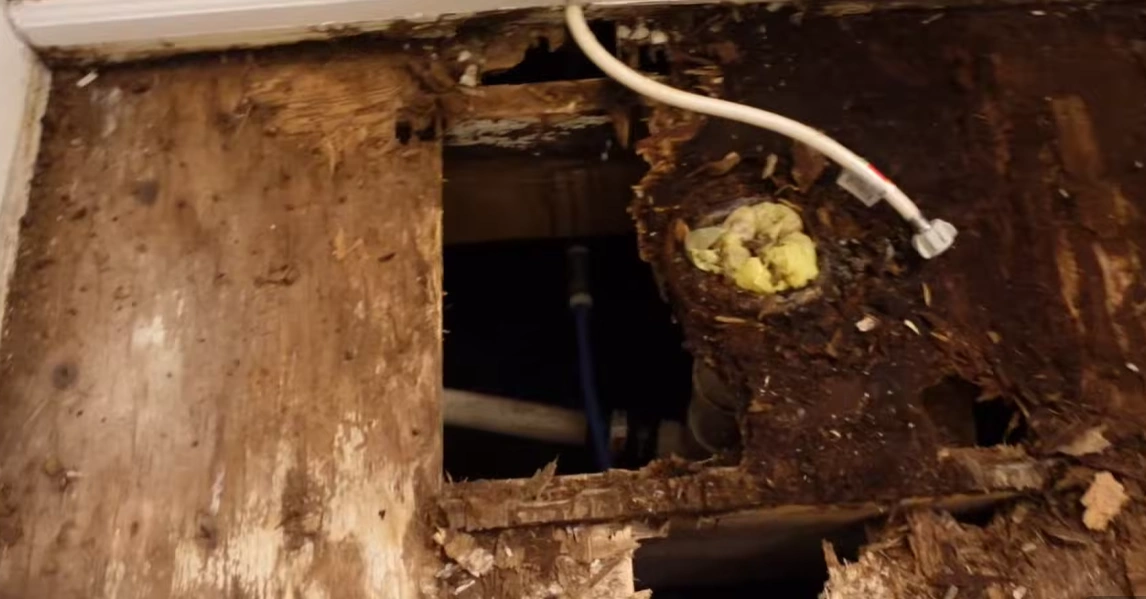
Upstairs bathroom supply lines and drain leaks, failed wax rings, ice-maker and dishwasher lines on the floor above — and roofs compromised by June 2026’s baseball-size hail or March 2025’s 70+ mph gusts. In the Near South’s older housing stock, aging galvanized plumbing and worn flashing are frequent culprits. We trace the true source with moisture meters before opening anything.
The lineup, roughly in order of how often we see them:
Upstairs plumbing.. Toilet supply lines, sink drains, shower pans, and tub overflows. A slow drain leak can wet a ceiling cavity for months before the stain appears — by which point the subfloor above may be rotted.
Hail-damaged roofing.. June 2026’s baseball-size hail bruised shingles across Lincoln. The bruise cracks, water enters, and the leak path runs down the roof deck into the attic and through the ceiling below.
Wind-lifted flashing.. March 2025’s 70+ mph gusts lifted flashing around chimneys, vents, and valleys. Each lifted edge is a funnel for the next rain.
Ice-maker and dishwasher lines.. Small-diameter supply lines on the floor above, often with cheap saddle valves. When they let go, they run until someone notices.
Attic condensation and ice dams.. Less common in Lincoln than in Minnesota, but January freeze-thaw can still drive attic moisture that drips onto ceiling drywall.
In the Near South’s older homes — some of the city’s oldest housing stock — galvanized supply lines past their lifespan and original flashing are frequent culprits. University Place’s early-1900s homes carry similar vintage plumbing. Newer homes aren’t immune; they just fail differently, usually at appliance connections and roof penetrations.
Why Wet Ceilings Collapse (and How We Prevent It)
Drywall loses strength as it saturates — a ceiling holding gallons of trapped water can let go without warning, especially with wet insulation above it. We relieve trapped water in a controlled way, remove drywall that’s lost integrity, and dry the cavity with directed airflow. If your ceiling is sagging or bulging, keep clear and call +1 (402) 227-8606.
The physics are simple and unforgiving. A 4×8 sheet of drywall weighs about 50 pounds dry; saturated, with wet insulation pressing down on it, the load multiplies — and the gypsum core that’s supposed to hold the fasteners is turning to mush. Collapse doesn’t always give warning, but the signs above (sagging, bulging, bubbling) are the ceiling telling you it’s close.
Our approach: we don’t just poke a hole and hope. We map the wet area with meters, relieve trapped water in a controlled drainage pattern, remove drywall that’s lost structural integrity, and dry the cavity with directed airflow before rebuilding. If your ceiling is actively sagging, don’t stand under it to “take a look” — call us and keep the room clear.
Water Damage Can't Wait
Every hour you wait, the damage spreads. Call now and get a straight answer about timing and next steps.
Our Ceiling Repair Process, Start to Finish
We find the source with meters and thermal imaging, stop the leak, extract trapped water, dry the cavity, cut out compromised drywall and insulation, treat for mold, then rebuild — new drywall, texture matched to your ceiling, and paint. As a registered Nebraska contractor, one crew handles the water damage and the rebuild, so there’s no handoff gap.
Source tracing.. Moisture meters and thermal imaging find the leak’s true origin — the roof penetration, the plumbing joint, the failed flashing — before any drywall comes down.
Stop the leak.. Roof issue? We coordinate emergency tarping. Plumbing? The line gets repaired or capped. Drying a ceiling under an active leak is mopping with the tap running.
Controlled water release.. Trapped water is drained in a planned pattern, not left to find its own way down.
Cavity drying.. Directed airflow and dehumidification dry the joist bays, with meter readings verifying the framing — not just the surface — reaches dry standard.
Selective removal.. Drywall and insulation that can’t be saved come out. Anything colonized with mold is remediated under containment with HEPA filtration.
Rebuild.. New drywall, texture matched to your existing ceiling (orange peel, knockdown, smooth — we match it), and paint blended to the room.
The full restoration sequence — including how drying science and insurance documentation work — is on our water damage repair page. Storm-caused ceiling damage connects to storm damage restoration; upstairs pipe bursts to burst pipe repair; and if mold has taken hold, mold remediation. Questions? Reach us on the contact page.
Frequently Asked Questions
Will my homeowners insurance cover roof leak repairs and water damage?
If the leak traces to a covered event — hail, wind, or storm damage — insurers typically pay for both the roof repair and the interior ceiling damage, less your deductible. A leak from old age or neglected maintenance is usually denied. Either way, document the stain’s growth with dated photos and mitigate quickly to protect the claim.
Where is the first place a homeowner should look for water damage?
Look up, not down: ceilings under bathrooms and kitchens, where supply lines and drains run, and ceilings under the roof after hail season. Water travels along joists, so the stain’s location rarely marks the leak’s source. Brown rings, bubbling paint, and sagging drywall are the early warnings — investigate before they become collapses.
How expensive is it to fix water damage?
Ceiling jobs range from drying and repainting a small stain to replacing saturated drywall, insulation, and the failed pipe or flashing that caused it. Nationally, Angi’s 2026 benchmark averages about $3,860 (range $1,383–$6,384) — not a Lincoln quote. Catching it at the stain stage, before sagging, is the difference between a patch and a rebuild.
What does water damage restoration include?
For ceilings: locating the leak’s true source (water travels along joists), extracting any trapped water, drying the ceiling cavity with directed airflow, removing drywall that’s lost structural integrity, treating for mold, then rebuilding — drywall, texture, and paint matched to the room. Call +1 (402) 227-8606 and one crew handles it all.
How long does it take for mold to start after a flooded basement?
The EPA’s 24–48-hour rule applies to ceiling cavities too — wet drywall and insulation above a ceiling are a dark, warm mold incubator. Because the leak is hidden, mold often gets a head start before the stain appears. If a ceiling has been wet more than two days, assume mold is possible and get it opened and dried professionally.
My basement has mold after it was flooded. What should I do?
Don’t disturb large mold patches — scrubbing spreads spores. Small areas (under ~10 sq ft) can be cleaned with proper protection, but post-flood mold usually means hidden growth behind drywall too. Call Water Damage Lincoln NE at +1 (402) 227-8606: we contain the area, remove contaminated materials, HEPA-filter the air, and dry the structure.
Ceiling stain spreading? Call Water Damage Lincoln NE at +1 (402) 227-8606 — 24/7 emergency response.
Water Damage Lincoln NE · 2805 S 48Th St, Lincoln, NE 68506 · +1 (402) 227-8606
Call Water Damage Lincoln NE Now
Water damage gets worse every hour you wait. Call now for fast emergency response across Lincoln and Lancaster County.