Water Damage Repair in Lincoln, NE: Cleanup to Rebuild
Lincoln's full-cycle water damage repair company — extraction, drying, mold remediation, and rebuild as one job, done by a registered Nebraska contractor. Call +1 (402) 227-8606.
24/7 emergency response across Lincoln & Lancaster County
From burst pipes in University Place to sump failures near Antelope Creek, we handle cleanup, remediation, and removal as one job — extraction, drying, mold remediation, and rebuild.
Lincoln Water System has delivered city water since 1883, and when that water ends up where it shouldn't — a split supply line, a failed water heater, a sump pump dead during an LES outage — the result is the same: soaked drywall, swelling subfloor, and a 24–48-hour clock before mold starts. Whether you call it water damage repair, water damage restoration, water mitigation, or water removal, it's one job with one sequence. This page is the complete guide to that sequence: how we triage the water, extract it, dry the structure, and rebuild — and how to tell a real restoration contractor from a guy with a wet-vac.
Category 1, 2, 3: Why the Water's Source Decides Everything
Clean Category 1 water needs fast drying but no disinfection. Gray Category 2 and black Category 3 demand extraction plus sanitization and protective gear. Misclassifying the category is how small jobs become health hazards. The industry standard is the ANSI/IICRC S500 — here's what the three categories mean in a Lincoln home:
Category 1 — Clean Water
A burst supply line, a failed ice-maker line, an overflowing sink with no contaminants. The catch: if it sits more than 24–48 hours, or passes through contaminated building materials, it degrades to Category 2. Speed keeps clean water clean.
Category 2 — Gray Water
Dishwasher or washing machine discharge, sump pump water with sediment, water that's wicked through dirty building materials. Needs extraction plus cleaning and disinfection. Carpet pad soaked with gray water is not salvageable.
Category 3 — Black Water
Sewage backups, toilet overflows with feces, and any floodwater from outside — Salt Creek overflow, storm runoff, groundwater intrusion. Grossly contaminated. Full protective protocols, removal of porous materials, thorough disinfection. Never a DIY job.
The category drives everything downstream: what equipment we bring, what gets removed versus dried, what disinfectants we use, and what the job costs. A contractor who treats sewage backup like a clean-water spill isn't saving you money — they're creating a health problem. When in doubt, we treat it as the higher category until testing says otherwise.
Step-by-Step: Our Water Damage Repair Process
Every job follows the same sequence: stop the source, extract standing water, map moisture, dry with commercial equipment and daily readings, remove what can't be saved, remediate mold, sanitize, then rebuild. Skipping steps — especially moisture mapping — is why DIY dry-outs fail.
Emergency response and source control. We arrive, confirm the water source is stopped (or stop it), and assess safety — electrical hazards, structural concerns, contamination category. If you have standing water right now, our emergency water removal page details what happens in the first hour.
Water extraction. Truck-mounted extraction removes standing water fast — hundreds of gallons per hour versus the trickle of a shop vac. This is the highest-leverage step in the entire job: every gallon removed now is moisture that doesn't soak deeper.
Moisture mapping. Pin meters, pinless meters, and thermal imaging find water hiding behind baseboards, under carpet pad, inside wall cavities, and beneath flooring. We document baseline readings — these become the drying targets and your insurance documentation.
Structural drying. Commercial air movers create airflow across wet surfaces; LGR dehumidifiers pull the evaporated moisture from the air. Equipment is placed based on the moisture map, not guesswork, and readings are taken daily until everything reaches dry standard.
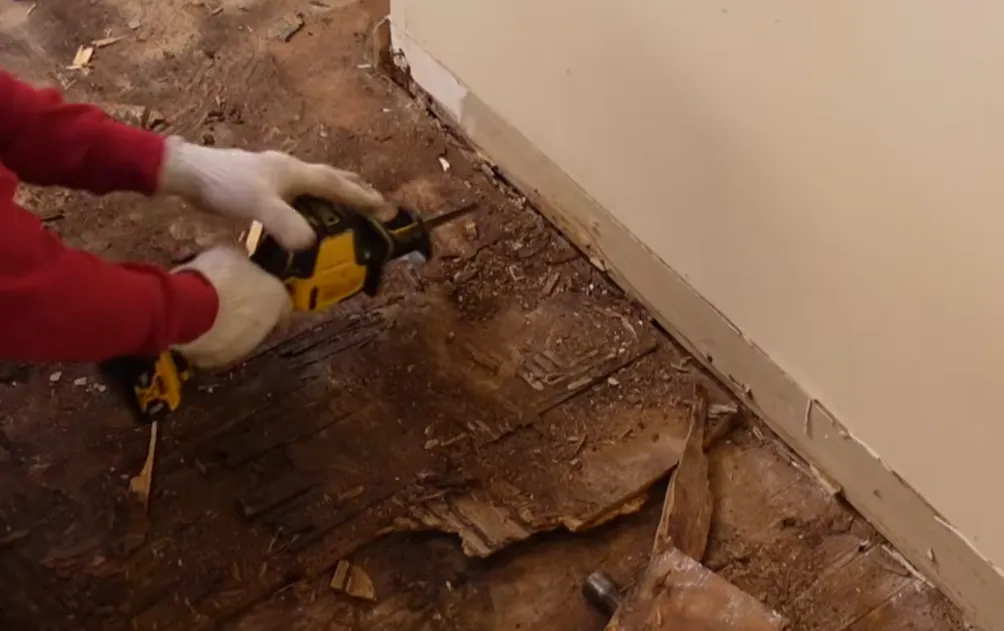
Selective demolition. Drywall that wicked water past the point of saving, matted insulation, saturated carpet pad, swollen MDF baseboards — out. We cut surgically (typically 2-foot flood cuts where appropriate) and preserve everything sound.
Mold remediation and sanitizing. Any colonization found is remediated under containment with HEPA filtration, following EPA guidance. Category 2 and 3 jobs get full disinfection of affected surfaces.
Rebuild. Drywall, insulation, baseboards, flooring, paint, texture — matched to your home. Final moisture verification, then walkthrough.
Moisture Mapping: The Step Most Companies Skip
Water hides — behind baseboards, under pad, inside wall cavities. We map it with pin and pinless moisture meters and thermal imaging before drying starts, so equipment goes where the water is. Without mapping, you dry blind: surfaces feel dry while framing stays wet, and mold follows. Ask any contractor how they verify dryness — "it feels dry" is not an answer.
Here's why this matters more than any other single step: drywall can feel dry to the touch at 16% moisture content while the wood framing behind it sits at 25% — well into the range where mold thrives and rot begins. A contractor who sets two fans and leaves is drying the air, not the structure.
✓Pin & pinless meters plus thermal imaging before drying starts
✓Photo-documented readings in every affected area, re-checked daily
✓Equipment comes out at dry standard — the meters decide, not the calendar
Those logs also go straight into your insurance file — exactly the documentation adjusters want to see.
Air Movers, Dehumidifiers, and Daily Readings
Drying is controlled evaporation: air movers push moisture out of materials, LGR dehumidifiers pull it from the air, and daily meter readings prove progress. A typical Lincoln basement takes 3–5 days of active drying; finished basements and hardwood take longer. We don't pull equipment until readings hit dry standard — the calendar doesn't decide, the meters do.
More fans isn't better
Air movers must be positioned to create airflow across wet surfaces in a controlled pattern. Random fan placement just moves humid air around.
Heat alone doesn't dry
Cranking the furnace without dehumidification raises the air's moisture-holding capacity — then moisture condenses on the coldest surfaces, often inside your walls.
Done when it looks dry? No
Paint and drywall can look perfectly fine while the subfloor or wall cavity behind them is still wet. Only meter readings confirm dryness.
Hardwood needs specialty drying
Floor-mat systems pull moisture through the boards while dehumidifiers handle the air. Standard drying warps wood floors.
For flooded basements specifically — our most-called job in Lincoln — the basement flooding guide covers sump failures, back flooding, and the finished-basement trap in detail.
Rebuild: Putting Your Home Back Together
After dry-out, we rebuild what demolition removed: drywall, insulation, baseboards, flooring, paint, and trim — matched to your home, not a contractor-grade swap. As a registered Nebraska contractor, we handle the full arc from extraction to final walkthrough, so you're not coordinating a restorer, a drywall crew, and a painter yourself.
This is where the rank-and-rent lead-gen model either earns its keep or doesn't. Plenty of operators will extract your water and vanish, leaving you to find a drywall contractor, a flooring installer, and a painter — three more strangers, three more schedules, three more chances for something to go wrong. We do the full arc: the same crew that mapped your moisture hangs your drywall. Drywall texture is matched to the existing finish. Paint is matched to the room, not "close enough." Flooring transitions are finished properly.
One thing we won't do: invent a timeline we can't keep. Drying takes what it takes — the meters decide — and rebuild starts after. We'd rather tell you five days honestly than promise two and disappear.
A note on Nebraska contractor status: Nebraska has no statewide general contractor license — only Nebraska Department of Labor contractor registration under the Contractor Registration Act. Any company flashing a "license number" for general contracting in Nebraska is showing you something that doesn't exist. What matters is NDOL registration, insurance, proper equipment, and documented process. That's the filter to use — and it's the subject of our contractor vetting guide.
LFR Battalion Chief Mark Majors put the October 2026 mechanism plainly to 1011 NOW: runoff causing "streams and creeks to crest" creates "back flooding" — and back flooding is what filled hundreds of Lincoln basements that week, regardless of who did the restoration.
What It Costs: Honest Benchmarks
We don't quote unseen jobs over the phone — anyone who does is guessing. What we can give you are national benchmarks to sanity-check any bid, from Angi's 2026 data (national benchmarks, not Lincoln quotes):
$3,860
Average restoration job
Angi 2026 national benchmark
Range: $1,383–$6,384
$3.50–$7.50
Per sq ft by category
Clean $3.50 · Gray $5.25
Black $7.50
$2,300–$6,200
Mold remediation
When needed
Angi 2026 national benchmark
Your actual cost depends on category, square footage, how long the water sat, and how much demolition the drying requires. Our water damage restoration cost page breaks this down further. The two cheapest moves you control: call fast, and don't let anyone demolish before moisture readings justify it.
If mold has already taken hold, see mold remediation. For burst pipes specifically — Lincoln's January specialty — see our burst pipe guide; for wood floors, the hardwood page covers specialty drying. Questions? The contact page reaches us directly.
Frequently Asked Questions
What does water damage restoration include?
Full-cycle restoration: emergency water extraction, moisture mapping, structural drying and dehumidification, removal of unsalvageable materials, mold remediation, sanitizing, and rebuild of drywall, flooring, and trim. Category 1, 2, or 3 water gets different protocols. One call to +1 (402) 227-8606 covers it start to finish.
How to estimate water damage restoration?
Pros estimate by category and square footage: clean water runs about $3.50/sq ft, gray water about $5.25, and black water about $7.50 — Angi 2026 national benchmarks, not Lincoln quotes. Add demolition, drying days, and rebuild materials. Honest estimates come from on-site moisture readings, never phone guesses. Call +1 (402) 227-8606 for an assessment.
How expensive is it to fix water damage?
It scales with category and area. Clean-water extraction from one room is the low end; black-water sewage across a finished basement is the high end. Angi's 2026 national benchmark — not a Lincoln quote — averages about $3,860, ranging $1,383–$6,384. The two biggest cost drivers are how long water sat and how much demolition the drying requires.
Is water restoration worth it?
Almost always, when the structure is sound. Professional drying saves flooring, framing, and drywall that DIY fans can't — and undried moisture becomes mold, rot, and a disclosure problem at sale. Compare the restoration cost against your deductible and the home's value, not against doing nothing, because doing nothing always costs more later.
Why should I hire a licensed restoration company instead of a general contractor?
In Nebraska the premise needs correcting: the state has no general contractor license — only Nebraska Department of Labor contractor registration. So "licensed restoration company" is the wrong filter. The right question is registered specialist vs. fly-by-night: restoration needs moisture meters, commercial drying gear, and Category 1/2/3 protocols most general contractors don't carry.
How much should water remediation cost?
Use per-square-foot benchmarks as a sanity check: about $3.50/sq ft for clean water, $5.25 for gray, $7.50 for black — Angi 2026 national benchmarks, not Lincoln quotes. A 500-sq-ft clean-water job lands far below a 500-sq-ft sewage job. Demolition, drying time, and rebuild materials move the final number; get it itemized in writing.
Water mitigation / recovery: what should it cost?
Mitigation — extraction, drying, and demo of unsalvageable materials — is the front half of the bill; recovery/rebuild is the back half. National benchmarks (Angi 2026, not Lincoln quotes) average about $3,860 total, ranging $1,383–$6,384. Mitigation alone often runs a fraction of that. Insist on a line-item scope separating mitigation from rebuild so you can compare bids apples to apples.
How expensive is Servpro for water damage?
We can't quote a competitor's pricing — franchise costs vary by owner, job, and market. Use the same yardstick for any company: Angi's 2026 national benchmark averages about $3,860 (range $1,383–$6,384), not a Lincoln quote. Compare itemized scopes, drying equipment, daily moisture logs, and NDOL registration — not brand names — and get everything in writing.
My basement just flooded. What should I do?
Prioritize safety: cut power to the flooded area if you can do it dry, and keep kids and pets out — assume any standing water may be contaminated. Call Water Damage Lincoln NE at +1 (402) 227-8606 for emergency extraction, photograph damage for insurance, and move dry valuables upstairs. Fast action beats perfect action here.
How long does it take for mold to start after a flooded basement?
The EPA says mold can begin growing within 24–48 hours on wet drywall, wood, and carpet — and Lincoln's humid summers speed that up. Visible colonies often appear in 3–5 days, with musty odor arriving first. This is why extraction and dehumidification should start the same day the water does, not next week.
Water Damage in Your Home?
Call Water Damage Lincoln NE at +1 (402) 227-8606 — 24/7 emergency response. Extraction, drying, mold remediation, and rebuild as one job.
Water Damage Lincoln NE · 2805 S 48Th St, Lincoln, NE 68506