Emergency Water Extraction in Lincoln, NE
Water Damage Lincoln NE provides emergency water extraction in Lincoln, Nebraska — truck-mounted and portable extractors that pull hundreds of gallons per hour from flooded basements, offices, and crawlspaces. Call +1 (402) 227-8606. When Salt Creek back-flooding fills a North Bottoms basement, extraction is the first and highest-impact work we do.
24/7 emergency response across Lincoln & Lancaster County
Every restoration job has a sequence, and extraction is step one — before drying, before demolition, before anything else. Standing water is the damage multiplier: every hour it sits, it wicks higher into drywall, deeper into subfloor, and further under flooring. The EPA gives mold 24–48 hours to start on wet materials; fast extraction is what keeps your job a drying job instead of a demolition job. This page is about the extraction craft itself — the equipment, the process minute by minute, and what has to happen before the dehumidifiers even arrive. (If you’re asking how fast a crew can reach you, our 24/7 emergency response page answers that; this page is about what we do with the water once we’re there.)
The First 60 Minutes: What Happens When the Crew Arrives
The first 60 minutes follow a fixed sequence: safety sweep for electrical hazards and contamination, source control to stop the inflow, standing-water extraction with truck-mounted equipment, and a first-pass moisture check that hands off to the drying phase. You get a written scope and photo documentation before we leave — the claim file starts on arrival, not days later.
Minute by minute, it looks like this. Minutes 0–10: safety sweep. We check for electrified water, structural concerns, and the water’s category — clean (Category 1, supply line), gray (Category 2, appliances or sump discharge), or black (Category 3, sewage or floodwater). Category 3 means protective protocols go on before anything else, because as Lincoln Fire & Rescue demonstrated during the October 2026 rescues, floodwater is contaminated water — responders put life jackets on rescued occupants specifically to protect them from it. Minutes 0–15: source control. A burst pipe still flowing gets its main shut. A failed sump gets assessed — power, pump, or capacity — while extraction starts around it. Minutes 10–30: extraction begins. This is the fastest, highest-impact work in the entire restoration: hundreds of gallons per hour coming out of your building. Minutes 20–45: the handoff check. Meters take first readings so the structural drying phase starts with a baseline, not a guess.
24-48 hours
Mold clock
EPA — the whole job races this
12-24 in
How far drywall wicks upward
Every extra hour pushes the line higher
~$3,860
National avg restoration
Angi 2026 benchmark, not a Lincoln quote
Truck-Mounted vs. Portable Extractors: The Right Machine for the Water
Truck-mounted extractors are the heavy artillery — high vacuum and high lift pulling hundreds of gallons per hour through long hoses, ideal for deep standing water across large areas. Portable extractors go where the truck can’t: upper floors, tight crawlspaces, buildings with no close vehicle access, and precision work like weighted carpet extraction. We bring both, because Lincoln losses come in both shapes.
The truck mount wins on raw power. Parked outside your home near 27th & Holdrege or your shop off Cornhusker Highway, it runs hoses inside and pulls water continuously into a waste tank — no stopping to empty, no buckets, no breaks. For a basement with four inches of water across 800 square feet, that’s the difference between hours and days. The portable wins on access: a third-floor condo leak, a crawlspace with 18 inches of clearance, a commercial kitchen where hoses can’t run through the dining room. Portables also do the precision work — weighted “ride-on” style extraction that presses water out of carpet and pad, and sub-surface extraction tools that pull water from under flooring without tearing it up first. The honest version: the machine matters less than the operator’s judgment about which machine, in which order, on your specific water.
The Standing-Water Removal Process, Step by Step
Standing-water removal runs in order: bulk water out first, then water trapped in carpet and pad, then water under and inside materials — each with its own tool and its own decision. Skipping a step is how moisture gets left behind to grow mold.
Step 1 — Bulk extraction. Standing water comes out with the truck mount or high-capacity portable. This is pure volume work: the faster the bulk water leaves, the less wicks into walls and the less the category can escalate (clean water left sitting becomes gray water as it picks up contaminants — time literally degrades your water category).
Step 2 — Carpet and pad. Carpet gets weighted extraction — a tool the operator stands on to press water from the fibers and pad. Then the decision: pad soaked with clean water, extracted fast, can sometimes be saved; pad that sat in gray or black water gets removed and discarded, always. Carpet itself can often be dried in place after proper extraction and sanitizing; carpet that floated off its tack strips or sat in sewage gets pulled.
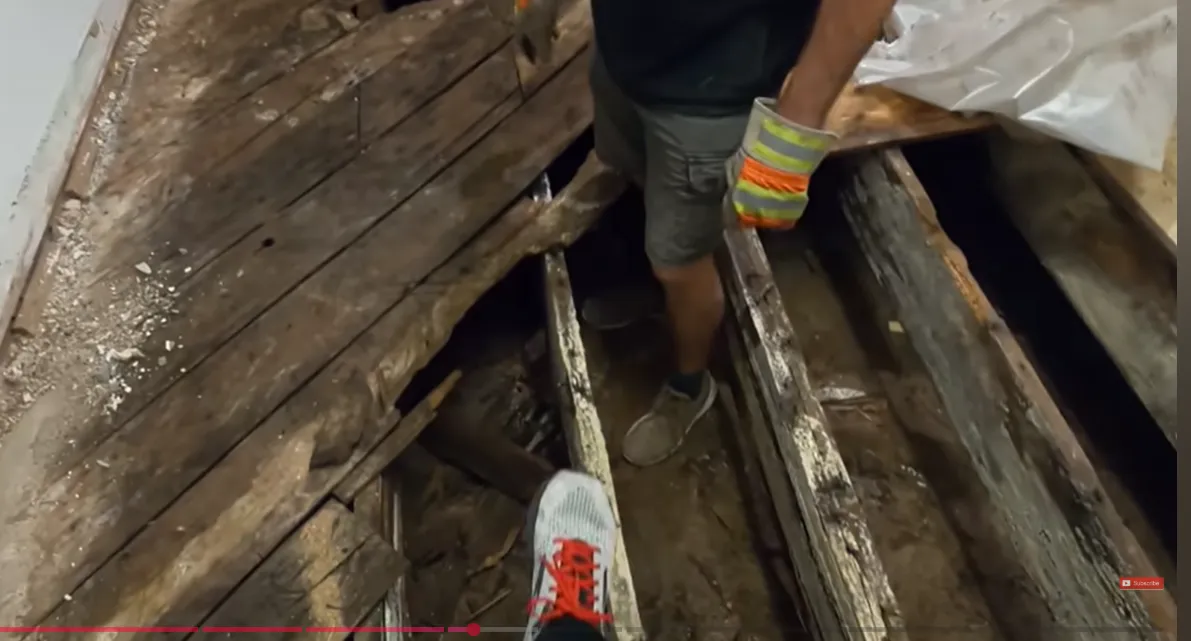
Step 3 — Sub-surface water. Water under vinyl, under laminate, pooled on subfloor beneath pulled carpet — extracted with hard-surface squeegee wands and sub-surface tools. This is the step DIY misses entirely: the floor looks dry while a quarter inch of water sits on the subfloor underneath, feeding the joists.
Step 4 — Contents triage. Furniture gets blocked up on foam blocks or moved to dry areas; electronics go to high ground immediately. What’s unsalvageable gets documented for the claim before disposal — never thrown away without photos, because your adjuster needs to see it.
Step 5 — Debris and sediment. Floodwater and sewage leave silt, mud, and debris — shoveled and bagged out before drying equipment goes in, because dehumidifiers can’t dry through a layer of mud. Our flood cleanup page covers the full post-flood service when the water came from a storm.
What Happens Before Drying Begins — and Why the Order Matters
Before drying begins, five things happen in order: the source is stopped, electrical hazards are cleared, the water category is determined, bulk and trapped water are extracted, and a moisture map is built. Drying equipment placed before this sequence is complete just blows wet air around — which is why the order is the craft.
Each step protects the next. Source control first, because drying a room while water still flows in is bailing a boat with the plug out — a lesson Lincoln learned in October 2026, when Salt Creek kept rising after the rain stopped (Lincoln Fire & Rescue’s Battalion Chief Mark Majors called it “back flooding,” explaining that creeks crest from runoff “not because of the rainfall itself”). Electrical safety next, because water and panels don’t mix and no extraction is worth an injury. Category determination next, because Category 3 changes the protective gear, the disposal rules, and what gets demolished versus dried. Then extraction, then the moisture map — thermal imaging and pin meters finding what the extraction couldn’t reach. Only then do air movers and dehumidifiers earn their place. A company that shows up and immediately starts placing fans has skipped the thinking. We do the thinking first.
Water Damage Can't Wait
Every hour you wait, the damage spreads. Call now and get a straight answer about timing and next steps.
Why Speed Beats Equipment Size — the Math of the First Hours
Speed beats equipment size because standing water compounds: every hour, water wicks higher into drywall (12–24 inches upward is typical), migrates further under flooring, and degrades from clean Category 1 toward gray Category 2. A smaller extractor arriving in one hour prevents more damage than a bigger one arriving tomorrow. Call +1 (402) 227-8606 now — the clock is the damage.
The math is unforgiving. Drywall wicks water upward through its paper backing — a flood cut exists because the bottom foot or two of a wet wall is a write-off, and every extra hour of standing water pushes that line higher. Carpet pad is a sponge: extracted within hours it can sometimes be saved; left overnight it becomes a mold reservoir that must be discarded. Wood framing absorbs slowly but holds tenaciously — the longer it sits wet, the longer the drying phase runs and the higher the rebuild bill climbs. And the category clock runs the whole time: clean supply-line water left standing picks up contaminants from flooring, dust, and building materials, sliding from Category 1 toward Category 2, which changes the sanitizing protocol and what must be removed. During the October 2026 flood, the Nebraska State Patrol logged 71 motorist assists across the storm (via 1011 NOW) — water was everywhere, all at once, and the buildings that got extracted first were the buildings that dried fastest. Early callers don’t just get earlier slots; they get smaller jobs.
Frequently Asked Questions: Emergency Water Extraction in Lincoln
Straight answers to the questions Lincoln homeowners ask about water extraction — how fast, how it works, what happens to carpet, and what extraction costs. For standing water right now, call +1 (402) 227-8606.
If my basement flooded from heavy rain in Lincoln, NE, how quickly can you get here?
Call +1 (402) 227-8606 and we dispatch immediately — most Lincoln addresses see a crew the same day, often within the hour in normal conditions. During major storm events like the October 2026 flood, every restorer in the city runs at capacity and we triage honestly: active-flow and life-safety emergencies first, then standing-water jobs in call order. Calling during the storm beats calling after it.
What can I put in my basement to soak up water?
For minor seepage: towels, mops, and a wet/dry vacuum, plus fans running continuously. But absorbents don’t fix flooding — anything over an inch of standing water, water inside walls, or sewage needs truck-mounted extraction and professional drying. Soaking up the visible water without extracting what’s trapped under flooring and inside walls just hides the moisture that grows mold within 24–48 hours (EPA).
Can you extract water from carpet, or does the carpet have to come out?
Carpet can usually be extracted and dried in place using weighted extraction tools — if the water was clean and we got to it fast. Carpet pad is the deciding factor: clean-water pad extracted quickly can sometimes be saved, but pad soaked in gray or black water (sewage, floodwater) is always removed and discarded. Carpet that delaminated or sat in sewage gets pulled too — we’ll show you exactly why before anything comes out.
What happens to the water you pull out of my building?
Truck-mounted extractors pump it into onboard waste tanks, which we dispose of according to the water’s category — clean water can go to appropriate drainage; gray and black water (sewage, floodwater) are handled as contaminated waste. It never goes back into your plumbing or onto your lawn. Contaminated water disposal follows the same protocols as the rest of our Category 3 work — see our sewage backup cleanup page.
Is floodwater dangerous to touch during extraction?
Yes — treat all floodwater as contaminated. As Lincoln Fire & Rescue demonstrated during the October 2026 rescues, crews protected rescued occupants from the water itself because urban floodwater carries sewage, chemicals, fuel, and bacteria. Keep people and pets out of standing floodwater, don’t run HVAC that could spread contaminants, and let our crew — in proper protective gear — handle the extraction. The National Weather Service’s standing warning applies: “Turn around, don’t drown.”
Do you extract sewage, or is that a different service?
We extract it — sewage backup is squarely in our work, under full Category 3 protocols: protective equipment, professional extraction, removal of contaminated porous materials, disinfection of what remains, and proper disposal. It’s a different protocol than clean-water extraction, not a different company. If the water smells, is discolored, or came up through a floor drain or toilet, treat it as sewage and call +1 (402) 227-8606 immediately.
Can you live in a house with a flooded basement?
With clean water and power safely cut to the basement, usually yes — upstairs living space is unaffected while we extract and dry below. With sewage or floodwater contamination, stay out of the basement and avoid running the HVAC until professional extraction and sanitizing are complete. When in doubt, keep everyone upstairs and let us assess — we’ll give you a straight answer, not a sales pitch.
What should I do if my sump pump floods my basement?
First, check the obvious: is it getting power (breaker tripped? LES outage?), is the float switch stuck, is the discharge frozen or blocked? If you can’t get it running in minutes, start moving valuables upstairs and call +1 (402) 227-8606 — we’ll extract the standing water while you sort the pump. Then read our sump pump failure guide on battery backups, because a pump with no backup fails exactly when the storm is worst.
Should I file a home insurance claim for water damage?
File when the damage clearly exceeds your deductible and the cause is covered — sudden events like burst pipes and appliance failures are typically covered; floodwater and long-term seepage usually aren’t. If the repair cost is only slightly above your deductible, paying out of pocket can be smarter than putting a claim on your record. Get our written scope first, then decide — our insurance claims guide walks through the math.
How much does emergency water extraction cost?
Extraction is priced as part of the overall mitigation job, not as a standalone line item with a fixed price — it scales with gallons, square footage, water category, and access. Nationally, full water damage restoration averages ~$3,860, ranging $1,383–$6,384 (Angi, 2026 — national benchmark, not a Lincoln quote). Your written on-site scope breaks out exactly what your job costs before work starts — call +1 (402) 227-8606.
Call Water Damage Lincoln NE — Extraction Starts the Fix
Standing water is the damage multiplier, and every hour counts. Call +1 (402) 227-8606 now for emergency water extraction in Lincoln, NE: truck-mounted power, the right portable tools for tight spaces, source control before drying, and a moisture map that hands off cleanly to the drying phase. The puddle is the beginning of the job, not the job — we handle all of it.
Water Damage Lincoln NE · 2805 S 48Th St, Lincoln, NE 68506 · +1 (402) 227-8606